grapheme letterpress

Mandolin Brassaw, owner of Grapheme, with Pantone tea and her letterpress.

Mandolin Brassaw, owner of Grapheme, with Pantone tea and her letterpress.

July 1, 2016 - Daily Notes, From the Editor

She makes a soft impression, the sort that is subtle yet embedded richly with possibility and curiosity.

Handing me orange mint tea in a Pantone mug, she asks where I grew up. We're seated on the sofa in the big front window of Grapheme, a letterpress and creative shop in Seattle, and I am about to realize that Mandolin Brassaw and I played soccer on rivaling teams twenty years ago.

It's funny the way people make impressions. Now that I know she grew up in Silverton, Oregon, less than fifteen miles from my family's farm north of Salem, she does look familiar. I can recall a ghost of her in a jersey on a playing field in my memory. We reminisce about growing up rural in the Willamette Valley, and I ask about the path that brought her here, to own her own shop in the heart of Seattle's rapidly changing Central District.

"I was an English major at Willamette," she said. "I thought I'd become a professor. Later, I discovered I don't really love teaching prescribed things."

She was in graduate school at the University of Oregon when she bought the press from Stu Rasmussen, the mayor of Silverton and, incidentally, the first openly transgender mayor in the United States. 

"Stu and his partner were looking to get rid of it and said 'Make us an offer.'" Mandolin was a broke college student and the press was probably worth in the neighborhood of a few thousand dollars, she tells me. But she wanted it. She mustered all her reserves and courage and humbly offered them the $300 she could scrounge up, expecting to hear thank-you-but-that-will-not-do. 

"Stu said, 'I appreciate the offer, but I think it's too much. How about $200?,'" she recalls with a little smile that holds a fond memory and still beams from the inside with gratitude. 

I admit to Mandolin I did not know what a letterpress looked like until today, and ask if she'll show me how it works. The pressure from a large, heavy, smooth metal cylinder makes a permanent imprint on thick paper as it rolls over it. I think quietly to myself that certain people become impressed upon our hearts this way, too. Whatever lies beneath is what winds up making the mark.

Mandolin's father built the shelves for Grapheme's walls to complement the hanging divider she created out of old wooden printer letter boxes she purchased from a rummage sale at Seattle's School of Visual Concepts. 

On the shelves are many of her own designs, beautiful cards and artwork pressed with intention and inspiring curiosity, like star maps, solstice trajectories, and renderings of the way the moon moves and reflects change.

"We've sold nearly all our copies of Lucia," she tells me. "Everyone who sits down here picks it up and they have trouble putting it down." I beam when I hear this, of course.

Mandolin lives above her sweet shop on Union Street, with her husband and one-and-a-half-year-old daughter. On certain days, she teaches. Not prescribed lesson plans of collegiate level English literature, but the enormously more ambiguous lesson of how to use a letterpress to take what's inside you and make a permanent impression with it.

Visit her online at: grapheme-seattle.com. Take a class. Buy a card. Or an entire constellation. Be inspired. Tell her Lucia sent you.

xo
laura


Laura Lowery is the founder, editor and publisher of Lucia. She does her best to lead a creative life. Whether triumphant or stumbling, Laura shares daily notes (that are often weekly) here on luciajournal, including stories, behind-the-scenes happenings, little doses of inspiration, and large quantities of curiosity and heart. She is pleased to meet you.
foxgloves

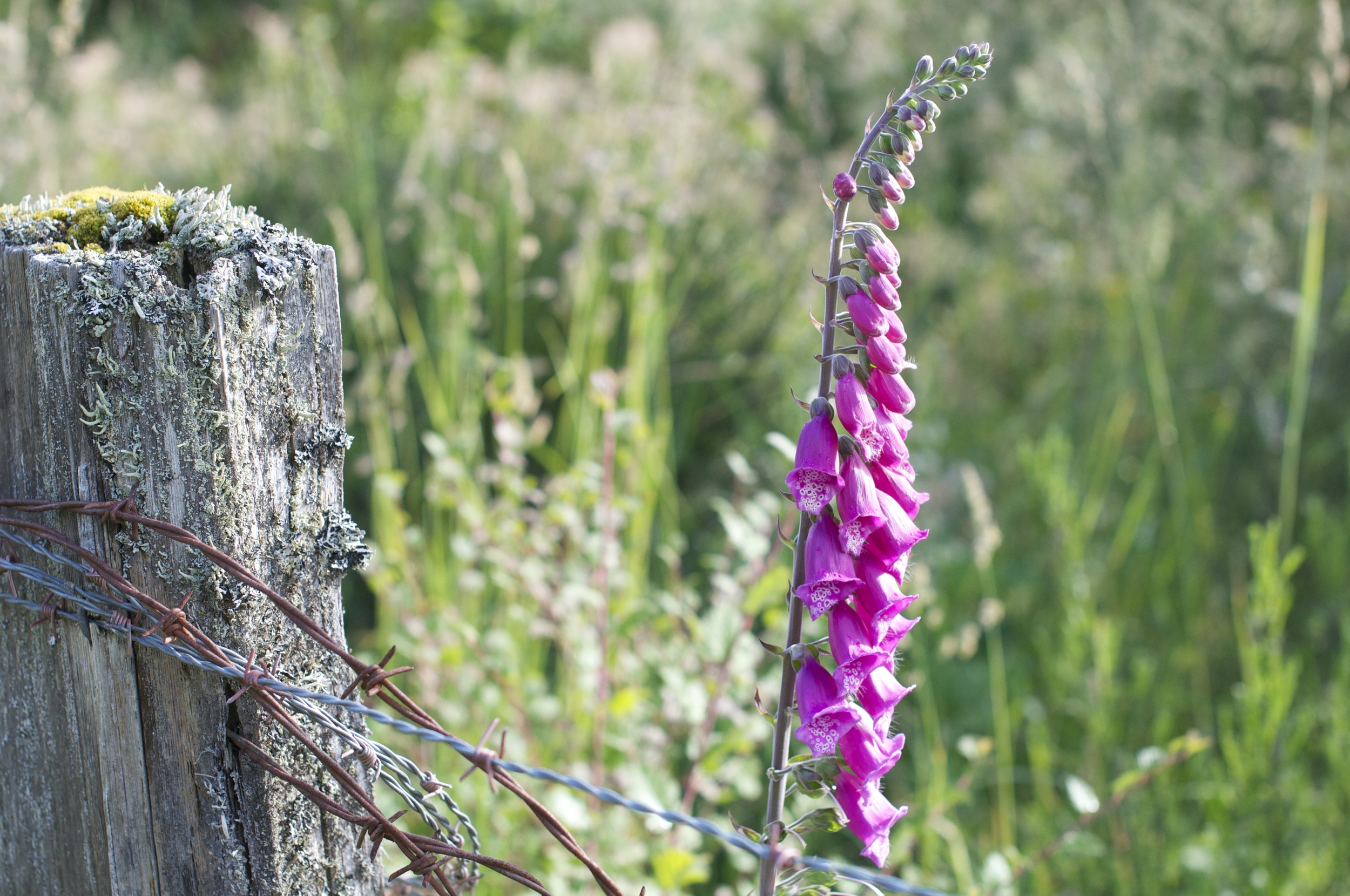
Foxgloves by Sarah Anne Childers

At the homestead my father takes my little girl across the road to pick daisies. They pluck white petals and fling them in a game she makes up, changing the rules as she goes because she can, he'll never call her on it. Then they examine the progress of the blackberries that lasso the brush. What will become fat finger-staining orbs after more time in the sun are still green nubs with tightly scrunched infant faces. Their transformation is inevitable and miraculous both.

There is a scraggly fence of barbed wire strung between low mossy posts. Beyond the fence to the south overgrown pasture tumbles roly-poly into forest sparse then dense before bumping into the Olympic Mountains rising jagged. (The Olympics continue to push toward the sky. They are old-but-young, still growing, bold with somewhere to be. Did you know? I keep this tidbit in my pocket and as with any good luck charm reach for it when I need reassurance. You can have it too; we’ll share.)

My daughter is drawn to the fence. In the city she navigates light rail stations and coasts her scooter across busy streets, but this barrier between mountains and country road puzzles her. What is in the pasture? Are we allowed to go? How would we get through? She wants answers but more so she wants the foxglove just over the fence. She'd like to smell the flowers. She'd like to pull the whole gangly plant from the grass by its furry stem. Perhaps a strand would survive to be plunked in the vase that sits in the center of the kitchen table but more likely she'd caress the weed beauty to bits like the poor dismantled daisies.  

Photo by Sarah Anne Childers

Photo by Sarah Anne Childers

"Don't go so close," I admonish as she inches toward the foxglove. I mean the barbed wire, not the flower. "Don't touch ... you'll get hurt ... and your new coat." I hear the whine and wringing hands in my tone and am annoyed at myself. I glare at the foxglove. I’m annoyed at it too. Why is it being so difficult? Why isn't it growing over here on this side of the fence? As if if it was, we might put the gloves on, slipping our paws into the little purple bells with mottled insides to protect against the metal spikes so that we could climb through unscathed to discover what lies beyond the fence, besides more foxgloves and scattered mounds of cow poop - one of the few things in this world I know as truth.

I don’t remember if these desires (for foxgloves, for answers) occurred to us, me and my little brother, decades ago when we traipsed across this same fence whenever we pleased. We had no concern for clothing or skin, our passage through the parallel lines of barbs perfected to a fluid modern dance. Indeed, fence crossing was our art form. Whoever came first to the fence pulled up on the middle line while half standing on the bottom one to create a kid-sized hole as the other ducked and stepped with knees high but not too high. Once through, the crosser turned back to reach for the smooth, safe part of the wire still held aloft, taking its weight and its burden in that wordless sign that meant: now you.  


Sarah Anne Childers is the online editor at luciajournal.com where she happily toggles between curating creatives as an editor and creatively curating ideas and the words they live in as a writer. 

sarah@luciajournal.com

effort and surrender

June 26, 2016 - Daily Notes, From the Editor

How do you ebb and when do you flow?

She brought a braid of sweetgrass (Hierochloe odorata), the kind only natives are allowed to gather. Removing her thick blade from its leather sheath, she sliced a few stems there on the gray dishtowel in my kitchen.

"It helps to clear and prepare a space for ceremony," she said as I handed her the blue teacup and a box of matches.

Five were in the circle on Saturday in my living room. The theme for the morning was "creative cycles" but our conversation wound around other things too, the way women do. We are creators.

One of them is writing a book. Another, a novel. A third is trying to make more mistakes this year. The fourth said her focus this summer is on rest. I was the fifth, and I am growing Lucia.

How do you know when to effort and when to surrender in your creative life? How do you ebb and when do you flow?

We talked about darkness and light, daytime and night. How for some, insomnia is a state in which to do both: surrender to the elusiveness of sleep, and sit up to softly flow. Maybe wrap oneself in a blanket and breathe the steam of herbal tea with a pen and some paper. Feel your own heart and hear what it is telling you. Commune with the moon.

We asked each other, what do you do with the mental chatter that assails and freezes the body in those dark hours, or in the first precious moments after waking in the morning?

"I write those thoughts all down, first thing," someone said. "Then I can get on with the rest of my day, because once they are on paper, even as chicken scratch notes, they are sort of already dealt with, in a way."

"But," I wondered aloud, "What do you do about the ones that cannot be put to rest so tidily?"

"Oh, those," she said. "I put those into a special jar labeled, 'Things I Cannot Control.' Like my boss being so mean, for example. Later, I take them outside and burn them. I release those things to the universe." 

She surrenders. 

Maybe this is the ultimate form of courage. Knowing what must be handed over to spirit is wise. Actually letting it go is brave. Then we can return again to the work that calls our souls, the work of creating.

This morning, I wrote down my uncontrollable worries. One by one, I tore them into little strips of paper. I gathered matches and what remained of the sweetgrass snips from yesterday. I set them on fire and watched the carefully written words weave their way into the Sunday sky above the maples in my backyard. 

"Here, universe. Please take these. They are yours. Thank you."

Then, I sat down to write.

xo
laura


Laura Lowery is the founder, editor and publisher of Lucia. She does her best to lead a creative life. Whether triumphant or stumbling, Laura shares daily notes (that are often weekly) here on luciajournal, including stories, behind-the-scenes happenings, little doses of inspiration, and large quantities of curiosity and heart. She is pleased to meet you.